
Four Order Types to Crush it in Trading!
Introduction
In this post, we discuss different order types and how to use them in trading. Although this is a post targeted for novices, even advanced traders can use a refresher!
There are two types of positions one can take. If you believe an asset will appreciate in value, you can buy it, or enter a long position. If you believe the asset will depreciate, you can sell it, or enter a short position. It may seem irrational to have the ability to sell something without first owning it, but short orders are a type of contract between you and the exchange that you will buy the asset back at a future time.
The Order Types
Whether you buy or sell, there are several ways to place the order, including Market Orders, Limit Orders, Stop Orders, and Stop Limit Orders. Although there are plenty more esoteric order types, we'll cover those four here.
Market Order
With a market order, you enter the position at market price. This does not guarantee you will be filled at that price, however. In fact, during periods of excessive volatility, or low liquidity, that disparity may be formidable. This price difference is called slippage.
Limit Order
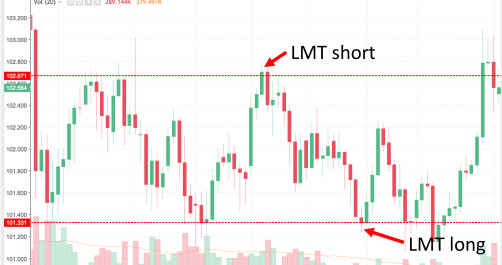
A limit order insures you will get filled at a given price or better. It serves to mitigate some of the risk with market orders. For example, if you are watching a stock trading at $100, and you are willing to pay $99.50, you can place a limit order to secure your entry at $99.50 or below, if the price retraces. Similarly, if you are eyeing a stock at $100, and wish to short the stock at $100.50, then a short limit order placed at $100.50 will sell the stock at $100.50 or above. Limit orders are especially good for order entry, to see that you get the best price possible, and for the same reason, they are useful for taking profits. Your desired price to exit your position and take profit is called the profit target.
Stop Order
A stop order executes a market order when the price of the asset hits a given value. They have priority on the exchange, so some of the slippage risk is mitigate. Due to flash crashes, this is actively enforced on the exchange. This immediacy distinguishes them from limit orders. A popular use for stop orders is to enter a trade on a breakout or to specify a stop loss if the trade does not go your way. For example, if you were to enter a long position in a stock at $100, your profit target might $104, and your stop loss might be $99. If the stock price goes south, you want to make sure you can exit the position as soon as possible by placing a stop order at $99 so as to take your losses before things get worse.
Stop Limit Order
A stop limit order triggers a limit order if the price hits a certain level. By combining the characteristic of a stop order with a limit order, the investor can fine-tune the entry into the position and not take the trade if the price reverses.